Alternative method using Velcro type fastening system. After the detector is removed from its protective pouch, apply a small patch of Velcro tape on its underside. A matching Velcro patch should be mounted in the center of the bottom of the plastic cup.
Radon in Soil Gas Testing Guidelines
"Although soil testing can be done, it cannot rule out the possibility that radon could be a problem in the house you build on a lot. Even if soil testing reveals low levels of radon gas in the soil, the amount of radon that may enter the finished house cannot be accurately predicted because one cannot predict the impact that the site preparation will have on introducing new radon pathways or the extent to which a vacuum will be produced by the house." Quoted from a great guide that is available, by EPA titled, "Building Radon Out". Another Great Publication for download: Building Radon Out (PDF format).
Survey Layout: Radon gas seeps out of the Earth's crust as a decay product of uranium, found in trace amounts throughout the ground. Structural features such as fault zones or joints affect the out-gassing of radon. The porosity of the soil also influences the transport of the gas. It is clear that no two survey sites are the same. A first guide is the local topography and geology. Flat, undisturbed plains areas may suggest fewer monitors than in tilted, faulted, disturbed geological formations. In a half-acre to acre lot, one should place one or two detectors in the center location of the proposed building, and a monitor in each quadrant of the property. If there are any known or recognizable geological features one should increase the number of monitors accordingly. The same general rule should be followed for larger building sites, such as apartment or condominium lots. In some cases, patterns for radon sampling are provided by other exploration requirements. For example, drill holes for pilings may be used. With proper precautions discussed below, radon measurements in such holes can be useful.
Empirical Rule: Historically it has been found that about 1% of the soil gas radon will enter a house that has been built conventionally and without extra radon protective measures. Thus if a house is to be built on 400+ pCi/l soil, it may be prudent to use polyethylene barriers, SGC matting or other measures in the construction.
Testing Radon in Soil Gas With Alpha Track (1 Week Test Duration)

The Alpha Track radon testing device should be mounted inside an inverted plastic cup.
Using a small push pin or equivalent, poke a hole in the bottom of the cup.
Use a piece of string or light fishing line, attach one end to the Alpha track test device and secure it with a knot.
Thread the other end of the string through the inside and up through the hole you drilled into the bottom.
Pull the device up to within approximately an inch and tie a knot on the outside of the cup so that the device is now being suspended inside of the inverted cup.
The cup has three functions.
- The inverted cup acts as a trap for the soil gas.
- The inverted cup also serves as a "diving bell" and in case of flooding of the site, the air bubble inside the cup keeps the monitor dry.
- Lastly, the cup serves as the support for the cover that is placed over the monitor to prevent interference from atmospheric air currents.
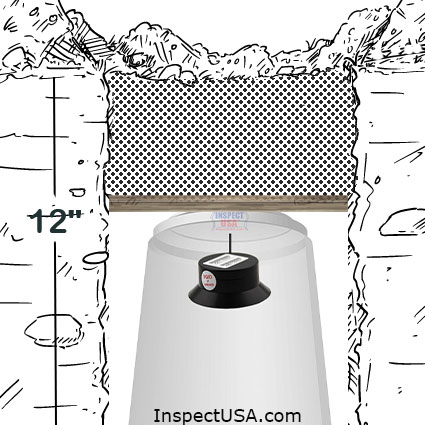
At each test location, dig a hole at least one foot deep with vertical walls.
- Place the inverted plastic cup (with the radon test device AT-100 attached) inside the hole at the bottom.
- Be sure to record the opening date, time and location on the supplied field data sheet & save for later use.
- A rigid, waterproof tile or plywood board (fit length x width of hole) is placed above the cup.
- Pack around the edges of the plywood shelf with rags, insulation, plastic or equivalent. Does not have to be air tight; purpose is to prevent dirt from going into the cup/detector chamber.
- Fill the rest of the hole with soil, piling a small mound to help deter ground water.
- A waterproof cover (i.e. plastic sheet, bucket etc) should be placed over the mounded dirt, during wet periods.
- Mark the location with a flag or other marker.
- It is important that the hole be closed off from surface air.
- The detectors should be left in place for at least one week.
- Record the closing date & time on the field data sheet.
Please indicate on data sheet that the test performed was for radon in soil gas.