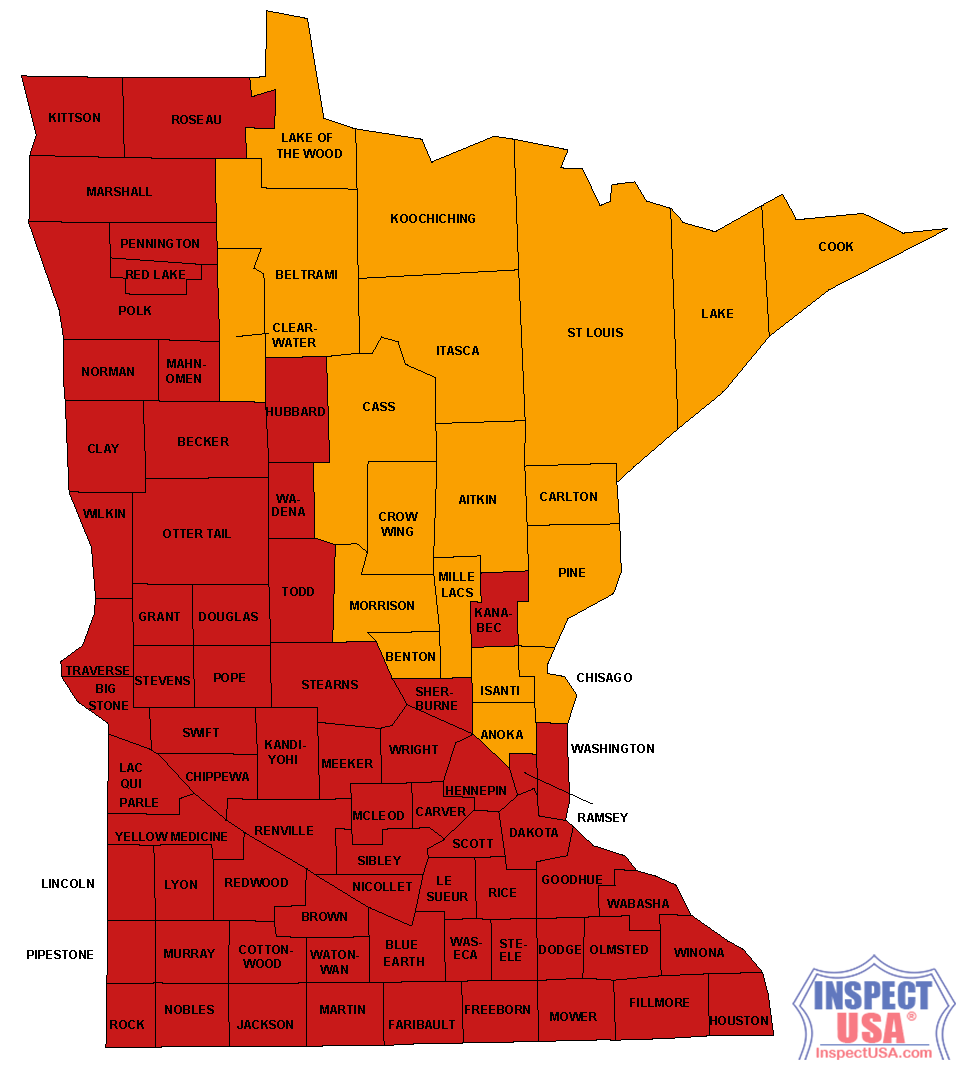
Minnesota
The Minnesota Department of Health (MDH) estimates that 2 in 5 homes in the state have radon levels that pose a health risk, and it is the leading cause of lung cancer among non-smokers. The MDH recommends that all homeowners in Minnesota test their homes for radon gas. If elevated levels of radon are detected, homeowners should consider installing a radon mitigation system to reduce the levels of radon in their homes. The MDH provides resources and information on radon testing and mitigation on its website. It also maintains a list of certified radon professionals who can assist homeowners with testing and mitigation. Minnesota law requires that radon testing be conducted in all public schools at least once every five years. The MDH provides information on its website about radon testing in schools and offers a radon testing kit loan program to schools. Overall, radon gas is a serious health concern in Minnesota, and homeowners and residents are encouraged to take steps to protect themselves and their families. Testing for radon and mitigating elevated levels can help prevent lung cancer and other health problems associated with radon gas.
United States EPA State Map of Radon Gas Concentration
The U.S. EPA and the U.S. Geological Survey have evaluated the radon potential in the U.S. and have developed this map is to assist National, State, and local organizations to target their resources and to assist building code officials in deciding whether radon-resistant features are applicable in new construction. This map is not intended to be used to determine if a home in a given zone should be tested for radon. Homes with elevated levels of radon have been found in all three zones. All homes should be tested regardless of geographic location. The map assigns each of the 3,141 counties in the U.S. to one of three zones based on radon potential. Each zone designation reflects the average short-term radon measurement that can be expected to be measured in a building without the implementation of radon control methods. The radon zone designation of the highest priority is Zone 1.
 |
Zone 1 | Highest Potential (greater than 4 pCi/L) |
 |
Zone 2 | Moderate Potential (from 2 to 4 pCi/L) |
 |
Zone 3 | Low Potential (less than 2 pCi/L) |