Lead Acid Pulse Load Battery Tester
CELL CHECKER (CELL03) US Made
Model CELL03 tests the State of Charge and Battery Condition for 2V, 4V, 6V, 8V and 12V Lead Acid Battery Types (SLA, AGM, Gel, Wet)
- Made and serviced in the U.S.A.
- Simple to operate, genuine Pulse Load testing with test results in 15 seconds.
- Measures battery performance under load, not just voltage or internal resistance.
- Computes State of Charge for lead acid battery types (SLA, AGM, Gel, Flooded).
- Tests battery condition - quickly and easily identifies weak or failing batteries.
- Tests 2-volt, 4-volt, 6-volt, 8-volt or 12-volt batteries up to 200A.
- Ideal for battery management and cell matching - reduce costs and increase reliability.
- Test capability modes:
- 2-volt [2-25AH].
- 4-volt [2-25AH].
- 6-volt [1-4AH, 5-15AH, 16-50AH, 20-100AH, 50-200AH].
- 8-volt [2-20AH, 20-100AH] 12-volt [1-4AH, 5-15AH,
16-50AH, 20-100AH, 50-200AH].
- Accurate pulse load testing.
- Identifies weak or failing batteries in alarm systems.
- Tests battery performance – not just voltage/internal resistance.
- Power (internal): 4 x AA batteries.
- Dimensions: 9.25 x 6.25 x 2 inches.
- Weight: 32 ounces / 908g.
- UPC: 5060184300926.
- NSN: 6625-01-675-0424.
- 1 year limited manufacturers warranty.
Options:
- Accessory Pack for Cell Checker (CELL-PAC) The SDI CELL-PAC accessory kit includes a protective soft case and a hanging
strap. The protective soft soft case comes equipped with a
Velcro® flap. The hanging strap has a quick release buckle which helps with quick fastening
to conduit, pipes, ladders, etc.
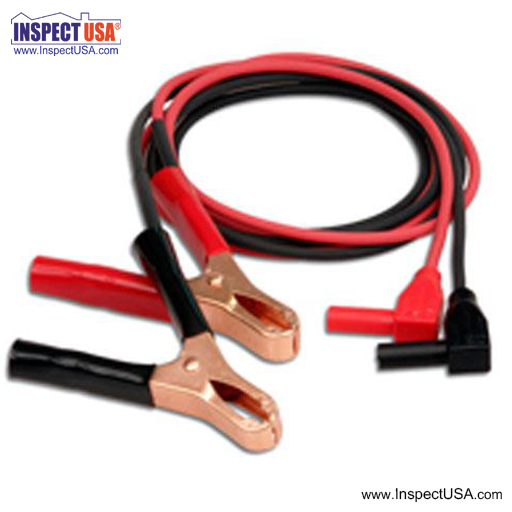
- Plier type replacement leads (CELL01LD)
- Regular replacement leads (CELL01RL)
INSTRUCTIONS FOR USE
- Turn on power switch (located to the right hand side of the unit)
- Select the type of battery to be tested by pressing the MODE key until
the LED next to the correct battery type is illuminated
- Connect the test leads to the battery terminals ensuring a good
connection with the red lead connecting to the positive terminal (+) and the
black lead connecting to the negative battery terminal (-)
- Press the TEST key
- LEDs will flash in sequence indicating the test is in progress. When the
test is complete one LED will remain lit indicating the battery’s state of
charge or remaining capacity
- Make two tests at five second intervals to verify that the battery has
stabilized and is delivering consistent power
- Turn off power switch after battery is disconnected
WHY PULSE LOAD BATTERY TESTING?
Battery voltage alone is not a reliable parameter for determining remaining
capacity and condition; it also does not indicate whether the battery will be
able to deliver power when placed under load. Rather than simply displaying a
voltage reading, cellchecker™ determines a battery’s remaining power capacity by
measuring its ability to maintain voltage levels while under load. The tester
then makes an assessment based on these readings and displays the remaining
percentage capacity of the battery.
Pulse load testers verify that a battery can deliver power by actually making
it deliver power. The duration and repetition of the load test cycle varies
depending on the battery type being tested. Factors that are considered when
determining the size and duration of the pulse load are battery design (high
rate or low rate), battery chemistry, and the battery’s typical application.
This helps ensure that the power demand on the battery during the pulse load
test will be comparable to what the battery experiences under normal operation
conditions.
Excerpts from: NFPA 72 Chapter 14 (14.4.2.2) CAN/ULC-S536-04.5.3.2
- it is imperative to determine whether a battery would be able to sustain
the necessary load for the required amount of time without failing.
Practically, only load testing can achieve this properly.
- battery testers that test a battery under no load do not accurately
simulate the battery’s performance in operating conditions.
- under load, the battery shall perform in accordance with the battery
manufacturer’s specifications. Each battery shall be inspected and tested to
confirm operability.
HOME
FOOD SAFETY PRODUCTS
EMAIL
RADON |
FIRE SAFETY
Visit our secure online Product Catalog
The contents of these WebPages are copyright protected. © All rights reserved Inspect USA, Inc.
Back Home