How much does one pound weigh? Well, that depends on many factors.
- Packaging
- The carrier selected (USPS, UPS, FedEx, DHL etc)
- When shipped (new dimensional weight rules went into effect 12/29/2014). Edited 1/12/2022.
- Exterior dimensions of your package (length, times width, times height, divided by a number). Dimensions should be rounded off to the closest whole number. For example, if the measurement is 12.5" use 13" and if the measurement is 12.49", use 12".
DIMS, Dimensional or volumetric weight is a term you will soon become very familiar, and even frustrated with, as a shipper. As a consumer you will pay for this one way or another. At checkout you may see the shipping weight as being greater than the product weight, resulting in a 'higher than expected' shipping cost. Many times that is a result of the dimensional weight, as long as the accessories included are the same. I have seen weight increases of 40% on average with smaller packages exceeding over a 350% increase. Wow. That is something to really pay attention to. This could change the bottom line really quick.
Shoppers searching for 'Free Shipping' will be paying it in a higher cost for the product. There is no way a 'for profit' company can afford to give the best pricing and free shipping. Did you really think there is free shipping. It is all baked in to the proverbial cake. If your package has a large size-to-weight ratio, you may need to consider your package's dimensional weight when calculating your shipping rates.
To sum it up, for most carriers you multiply the length, width, and height of the package, and divide the result by 139* and round up to the next whole number. For example if a package is labeled 6x4x4, the exterior dimensions are 6.75" x 4.5" x 4.75", that would equal 175 cubic inches. That would get divided 139*, which would be 1.26. That would be rounded up to 2 dimensional pounds. That is whether you ship the box empty or take it up to 2 pounds. Below are some illustrations and explanations from each of the main carriers. * Edited 1/2/2018 when the carriers reduced the factor from 166 to 139.
US Postal Service (usps.com)
 To find the dimensional weight, multiply the length, width, and height of the package and divide the result by 166 and round up to the next whole number. This is the dimensional weight in lbs. If it is greater than the actual weight of the package, use this weight to determine the shipping price. If the dimensional weight exceeds 70 pounds, the price will be at the 70 pound rate.
UPS - Domestic (both Air and Ground)
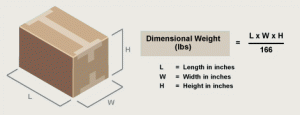
Divide the cubic size in inches by 139 to determine dimensional weight in pounds. Increase any fraction to the next whole pound.
UPS International: Divide the cubic size in inches by 139 to determine dimensional weight in pounds. Increase any fraction to the next whole pound.
DHL Express The Volumetric Tool (available on DHL's site) rounds each dimension (length, width and height) to the nearest whole number using standard rounding rules. The resulting dimensional weight is then rounded to the next full pound or half kilogram. For example, a box with dimensions of 30.4”(L) x 19.6”(W) x 19.5”(H), will be considered to be 30”(L) x 20”(W) x 20”(H) = 12,000 cubic inches, and will be divided by 139 = 86.3 lbs. for a “Dimensional Weight” of 87 lbs.