New Jersey Short Term Radon Test Kit with Pre-paid Return Mailer. NJ State fees , return postage & Lab Processing INCLUDED.
Liquid scintillation process.
Do-it-yourself kit will include:
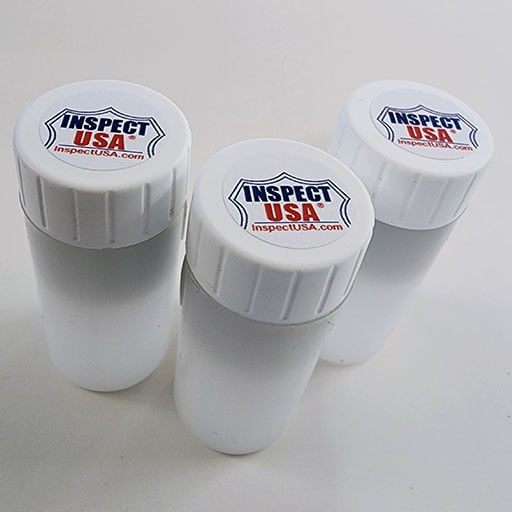
- (3) Short Term (48 to 96 hour exposure period) liquid scintillation vials.
- Pre-paid pre-addressed return mailer.
- Instructions. Extremely accurate & easy to use! Quick & reliable lab results are included in price. Results are available online within the next business day, after receiving them back at the lab. - click here for results.
LABS ARE NRSB & NJ CERTIFIED.
This test kit is intended for homeowners in the state of New Jersey to perform their own test. Each kit is intended to test (1) location of a property in accordance to New Jersey protocol.
For short-term radon measurements with exposure times between 48 hours and 96 hours, we utilize the liquid scintillation (LS) type of patented pharmaceutical-grade charcoal-silica adsorption material. Near 100% counting efficiencies allow for a monitor that is lighter in weight (0.4 ounce) and easier to handle than traditional charcoal canisters. High efficiency counting also means that fewer samples are lost due to excessive decay time.
Each detector is given a unique bar-coded identification number. A measurement with the LS device in initiated by removing the cap to allow radon-laden air to diffuse into the charcoal packet where the radon is adsorbed. A polyethylene foam plug ensures passive diffusion, preventing distortions caused by drafts and air currents. At the end of the exposure (two days), the device is resealed securely and returned to our lab for analysis.
In the laboratory, the exposed detectors are prepared for analysis by radon desorption techniques. A major fraction of the radon adsorbed on the carbon is transferred into a vial of liquid scintillation fluid. The vials of counting fluid are then loaded into an automated liquid scintillation counter. The total beta activity is then counted for a pre-set time or until the standard deviation of the counts is at 2.5%.
The total beta count, along with the customer supplied exposure data, is used to calculate the radon concentration. The typical uncertainty (standard deviation) of an LS result is ±10% and the minimum reported concentration is 0.5 pCi/l.
CONDUCTING THE TEST
If you do the test yourself, the process is very simple. You need only follow the testing instructions and complete the form that accompanies the test device. The device should then be mailed without delay to a laboratory using a pre-addressed envelope enclosed with the kit.
The following guidelines should be used by both homeowners and measurement companies.
For both long-term and short-term tests, the testing device must be placed:
- in the lowest livable level of the home -- that is, the lowest level of the home that is used, or could be used, as a living space. This would include, for example, a first floor without a basement, and a finished or unfinished basement, but not a crawl space.
- in a location where it will not be disturbed.
- at least 20 inches from the floor, at least 4 inches away from other objects and at least 36 inches away from doors, windows or other openings to the outside. The tests only need to be placed one foot away from exterior walls that have no openings. If suspended from the ceiling, it should be in the general breathing zone.
Test kits should not be placed:
- in areas exposed to direct sunlight, drafts, high heat, or high humidity; or
- in kitchens, bathrooms, laundry rooms or closets.
In addition, attic and window fans, fireplaces and wood stoves (unless they are the primary heat source) should not be used for the duration of the test. They will affect air pressure in the house which will in turn affect radon concentrations. Air conditioning can be used if it circulates inside air rather than bringing in air from the outside.
For short-term tests, it is very important to maintain "closed house conditions," since ventilation can increase or decrease radon levels in unpredictable ways. This means all windows and doors that let in outside air, on all floors, must be kept closed except for normal entrances and exits. You need to maintain closed house conditions until the short-term test is finished. For tests that last less than four days, closed house conditions must be started at least 12 hours before you begin the test.
Lab must receive within 8 days from closing the canisters or test is invalid. There is no refund.
INTERPRETING YOUR TEST RESULTS
The test report will usually give your radon reading in picoCuries per liter (pCi/L). PicoCuries per liter is a measure of how much radiation is in a liter of air, which is about the size of a quart. Sometimes results will be given in Working Levels (WL). You can calculate the pCi/L level by multiplying the WL reading by 200.
The DEP and the Environmental Protection Agency (EPA) both recommend that you take action to mitigate your home if your test results indicate radon levels of 4.0 pCi/L of radon or more. If you used two or more short-term tests at the same location, the results should be averaged.
There is no truly "safe" level of radon since lung cancer can result from very low exposures to radon – however, the risk decreases as the radon concentration decreases. If your test result is less than 4.0 pCi/L, you may want to discuss with mitigation companies whether the radon level can be brought down still further. In about half of the homes that have been mitigated in New Jersey, radon levels have been brought to less than 1 pCi/L.
Radon Risk for Smokers and Nonsmokers
(Source: National Academy of Sciences, Biological Effects of Ionizing Radiation, Sixth Report, 1998)
|
Radon Level
(in pCi/L)
|
Odds for non-smokers* of developing lung cancer due to radon if exposed to this level over a lifetime
|
Odds for smokers* of developing lung cancer due to radon if exposed to this level over a lifetime**
|
|
20
|
1 in 27
|
1 in 5
|
|
8
|
1 in 68
|
1 in 13
|
|
4
|
1 in 135
|
1 in 26
|
|
2
|
1 in 270
|
1 in 52
|
|
0.4***
|
1 in 1,350
|
1 in 260
|
*Smokers are defined as individuals who have smoked at least 100 cigarettes in a lifetime; non-smokers have never smoked or smoked less than 100 cigarettes in a lifetime.
**This is in addition to the risk of lung cancer from smoking itself.
***Average outdoor radon concentration.