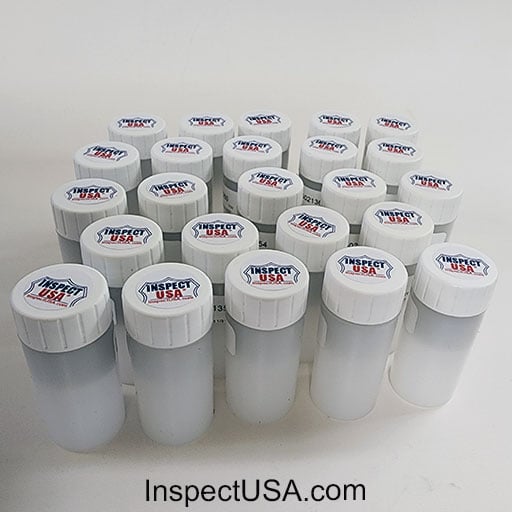
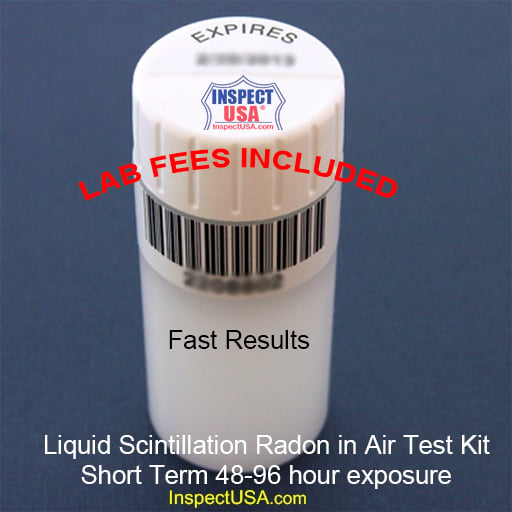
(24) Short Term Radon Gas Test Liquid Scintillation Vials (Bulk Packed) LAB FEES INCLUDED!
Inspect USA Short Term Radon Gas liquid scintillation Test Vials. Calibrated at the laboratory for an exposure of 48 to 96 hours.
Lab results (reports) are available next business day (after 4.30 PM eastern) when canister(s) received prior to 11 AM Eastern, with completed data sheet.
Lab must receive within 8 days from closing the canisters or test is invalid. There is no refund.
Link to look up radon test results In order to retrieve results online, the test device serial number and the test site zip code are required. Results are emailed to one email address (must be included on data/info sheet).
Looking for individual test kits Link
Looking for bulk 100 packs. Link
- EPA recommends using 2 canisters per 1200 square foot dwelling.
- Exposure time: 48 hour minimum up to a 96 hour maximum.
- Extremely accurate & easy to use.
- LAB credentials provided on every lab report and is available upon request.
- Shelf life on the canister is approximately 24 months (expired canisters have no value and should be discarded).
Sample Radon Gas Report (Link opens in New Window)
Supplied with:
- (24) test vials (unopened vials have a shelf life of 2+ years)
- Each radon in air test canister order will include 1 pre-addressed Priority Mailer & (1) instruction / information form.
- Return shipping to the lab is not included.
 Download Instruction Sheet / Information Form
Not for use in New Jersey - Click here for NJ test kit
For short-term radon measurements with exposure times between 48 hours and 96 hours, we utilize the liquid scintillation (LS) type of patented pharmaceutical-grade charcoal-silica adsorption material. Near 100% counting efficiencies allow for a monitor that is lighter in weight (0.4 ounce) and easier to handle than traditional charcoal canisters. High efficiency counting also means that fewer samples are lost due to excessive decay time.
Each detector is given a unique bar-coded identification number. A measurement with the LS device in initiated by removing the cap to allow radon-laden air to diffuse into the charcoal packet where the radon is adsorbed. A polyethylene foam plug ensures passive diffusion, preventing distortions caused by drafts and air currents. At the end of the exposure (two days), the device is resealed securely and returned to our lab for analysis.
In the laboratory, the exposed detectors are prepared for analysis by radon desorption techniques. A major fraction of the radon adsorbed on the carbon is transferred into a vial of liquid scintillation fluid. The vials of counting fluid are then loaded into an automated liquid scintillation counter. The total beta activity is then counted for a pre-set time or until the standard deviation of the counts is at 2.5%.
The total beta count, along with the customer supplied exposure data, is used to calculate the radon concentration. The typical uncertainty (standard deviation) of an LS result is ±10% and the minimum reported concentration is 0.5 pCi/l.
Learn more about Radon (New window will open and take you to our Radon Information site)
Click here for NJ test kit
EPA Method #402-R-92-004 Liquid Scintillation / NRPP Device Code 8088 / NRSB Device Code 12193