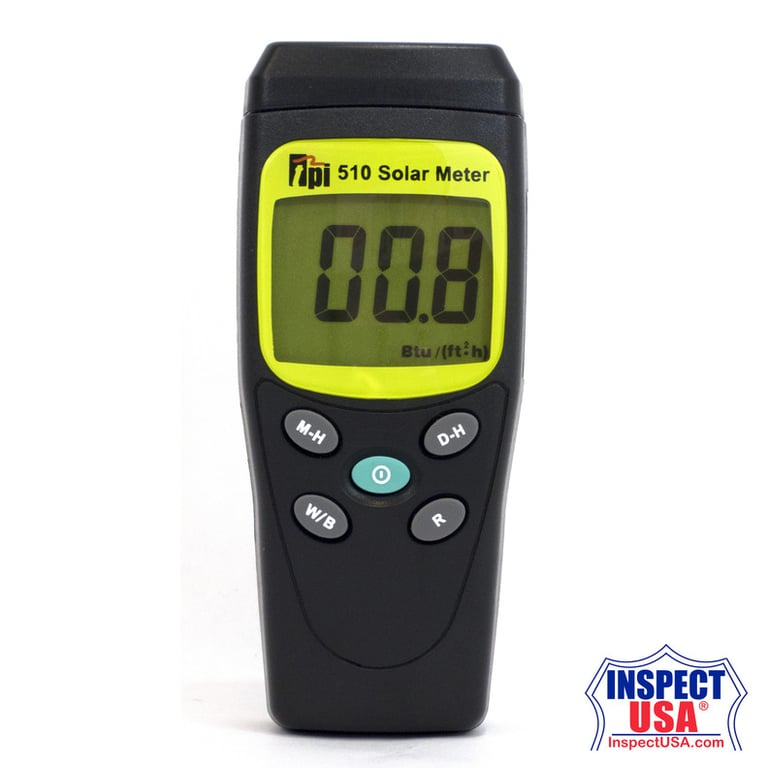
TPI TP-510 Solar Power Meter, Irradiance in W/m² or BTU per Square Foot Hour
The TPI TP-510 measures solar irradiance — the amount of radiant energy falling on a surface — and reads it directly in watts per square meter or BTU per square foot per hour. Point it at the sun and it tells you how much energy is arriving; point it through a window and it tells you how much is getting past the glass.
That makes it two instruments in one. For solar work it finds the angle of inclination that gives a panel the most energy, and it compares actual irradiance against what an array is producing so soiling, shading and degradation show up as a number rather than a hunch. For building and automotive work it measures the same thing on both sides of a pane of glass, which is the only honest way to demonstrate what a window film, a low-e coating or an awning is actually doing.
Readings update about four times a second. Data hold freezes the display, and a maximum and minimum function captures the extremes over an observation. An auto range button steps between the 199.9 and 1999 ranges, and the display shows OL if the reading exceeds the range in use.
Taking a reading means aiming the meter toward the sun, which puts the sun in your line of sight. Never look directly at the sun, with or without the instrument. Sight along the meter body rather than down it, and wear sunglasses.
Typical Applications
- Finding the optimal tilt and orientation for solar panels before they are mounted.
- Checking an installed array against available irradiance, to see whether output has fallen because of soiling, shading or panel degradation.
- Measuring the effectiveness of window film and solar tint, by comparing readings taken through the glass and with the window open.
- Automotive tint work, including before and after comparisons for the customer.
- Energy audits and home inspection — quantifying solar heat gain through glazing, skylights and doors.
- Verifying the performance of low-e glass, shading devices, awnings, screens and exterior blinds.
- Greenhouse and horticultural light level surveys.
- Solar thermal collector and solar water heater commissioning.
- Siting solar attic fans, landscape lighting and other solar powered equipment.
- Weathering, coatings and materials exposure testing.
- Comparing headlight and lamp output, and general light source comparison work.
- Classroom and STEM demonstrations of solar energy.
Features
- Direct reading solar irradiance measurement, no adjustment needed before use.
- Reads in W/m² or BTU/(ft²·h), selected by push button.
- Responds to all measurable light sources, including visible light generally.
- Two ranges, 199.9 and 1999, with a push button auto range control.
- Data hold freezes the displayed value.
- Maximum and minimum capture with recall.
- Overload indication: the display shows OL when the reading exceeds the range in use.
- Fast 0.25 second sampling time.
- 3-1/2 digit LCD with a low battery indicator.
- Approximately 100 hours of battery life from a single 9V battery.
- Pocket sized, and supplied with a carrying case and battery.
Specifications
- Measurement: solar irradiance, in W/m² or BTU/(ft²·h).
- Range: 0 to 1999 W/m², or 0 to 634 BTU/(ft²·h).
- Ranges available: 199.9 and 1999, selected with the auto range button.
- Resolution: 0.1 W/m² and 0.1 BTU/(ft²·h) on the 199.9 range.
- Accuracy: typically within ± 10 W/m² (± 3 BTU/(ft²·h)) or ± 5%, whichever is greater, in sunlight.
- Additional temperature induced error: ± 0.21 W/m² per °F (± 0.38 W/m² per °C), referenced to 77 °F (25 °C).
- Display: 3-1/2 digit LCD, maximum reading 1999.
- Sampling time: approximately 0.25 second.
- Over-input indication: display shows OL.
- Controls: power, maximum/minimum, unit (W/m² or BTU), data hold and auto range buttons.
- Dimensions: 5.2 x 2.4 x 1.5" (132 x 60 x 38 mm).
- Weight: 5.3 oz (150 g), approximate.
- Operating temperature and humidity: 41 to 104 °F (5 to 40 °C), below 80% RH.
- Storage temperature and humidity: 14 to 140 °F (-10 to 60 °C), below 70% RH.
- Operating altitude: below 6560 ft (2000 m).
- Operating environment: indoor use, pollution degree II.
- Power supply: one 9V battery (NEDA 1604, IEC 6F22, JIS 006P), included.
- Battery life: approximately 100 hours.
- Safety: conforms to EN 61010-1 for electronic measuring instruments.
- EMC: compliant and tested to EN 61326 (1997) + A1 (1998) + A2 (2001).
Getting a Comparable Reading
Irradiance changes minute to minute with sun angle and cloud. When you are comparing two conditions — window open against window closed, film against no film, one panel angle against another — take both readings from the same position, at the same aiming angle, within as short a span of time as you can manage. A pair of readings taken ten minutes apart under a moving sky is not a comparison.
NOTE: Full sunlight at sea level on a clear day is roughly 1000 W/m², or about 317 BTU/(ft²·h). That figure is a useful sanity check: a mid-day clear sky reading far from it usually means the meter is not aimed squarely at the sun.
NOTE: The meter zeros itself at power on. If the sensor cover is not fitted at that moment the display shows CAP. Fit the cover and let it zero again. If digits remain on the display after zeroing, repeat the zero adjustment.
Care and Maintenance
- This is a precision instrument. Observe the operating and storage specifications to avoid damage.
- Do not store the meter in direct sunlight, or anywhere hot or damp.
- Turn the power off after use, and remove the battery before long term storage so a leaking cell cannot damage the internal parts.
- Clean the instrument with a dry, soft cloth.
- Do not measure in wet locations, or where explosive or combustible gas, steam or excessive dust is present.
Accessories Included
- Carrying case.
- 9V battery.
- User manual.
- One year limited manufacturer's warranty against defects in materials and workmanship.