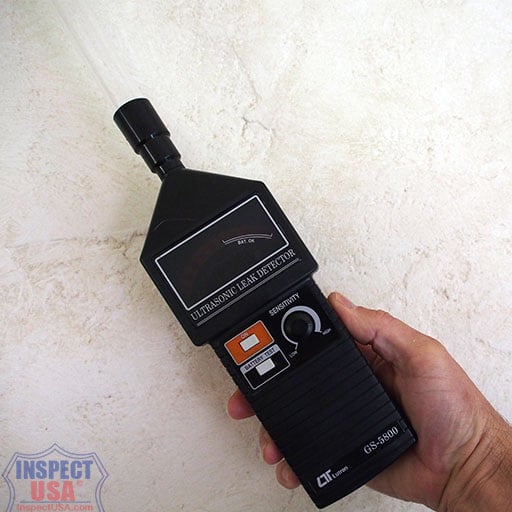
Lutron Ultrasonic Leak Detector is designed to locate the source of the ultrasonic emissions created during small air or gas leaks.
The ultrasonic leak detector picks up the noise which is generated by gas or air leaks, as well as high pressure liquid leaks. The leakage level is displayed by a Bargraph LED Display Panel, and converted to an audible sound by either internal buzzer or with an external earphone (optional). By detecting the ultrasonic sound created by turbulence and friction in industrial equipment, this instrument can help pinpoint compressed air leaks, refrigerant leaks, vacuum leaks, worn bearings, and internal leaks through valves and steam traps.
- Leakage Indicator with a Bar Graph LED display panel and an audible tone.
- Creates an audible tone by dividing the ultrasonic sound by 32.
- Time and convenience are also improved with ultrasonic detection since equipment may be tested while on-line.
- The LED display indicator of the detector is a relative measurement only.
- Frequency response: 20kHz to 100kHz.
- Power supply: (1) 9v alkaline battery or equivalent.
- Power consumption: Approx. 17mA DC.
- Operating temperature: 32° to 122°F (0° to 50° C).
- Operating humidity: less than 80% RH, non-condensing.
- Earphone jack.
- Dimensions: 10 x 2.8 x 1.1 inches (255x70x28mm) HxWxD.
- Weight: approx. 0.57 LB (including battery).
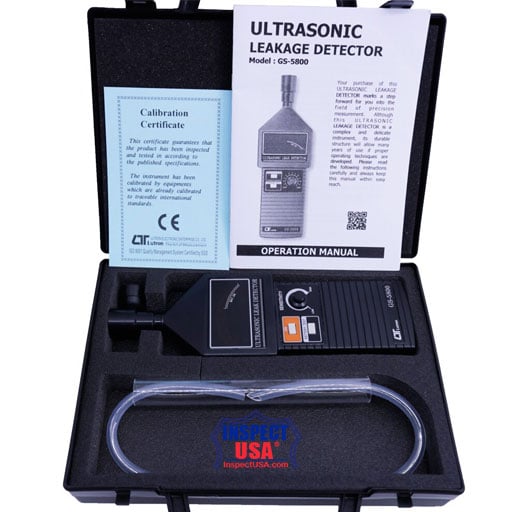
Supplied with:
- Operational Manual.
- Rubber bottle plug with plastic tubing.
- 1/2 inch PVC pipe.
- Hard shell padded case.
Optional High Frequency Transmitter GS-400

Theory of Ultrasonic Leak Detection
The human ear is capable of detecting sound frequencies up to approximately 18 kHz. Sound frequencies above 20 kHz are classified as ultrasonic and are not audible to humans.
Ultrasonic sound is highly directional in nature. This characteristic allows ultrasonic energy to be used to accurately pinpoint the exact origin of a sound source, making it ideal for locating the precise position of a gas leak.
According to basic principles of physics, gas always flows from a region of higher pressure to a region of lower pressure. When a pressure differential forces gas through a very small opening, turbulence is created at the leak site. This turbulent flow generates ultrasonic sound energy.
When gas passes through a small opening at a rate greater than approximately 10−5 atmospheric milliliters per second (mL/s), the flow typically enters the viscous flow regime. As the pressure differential across the opening increases, the velocity of the gas also increases. With higher velocity, the frequency content of the emitted ultrasonic sound rises accordingly.
The resulting ultrasonic emission spans a broad range of frequencies and is commonly described as white noise.
The velocity and volume of a leaking gas are also affected by the viscosity of the gas itself. Gases with higher viscosity flow more slowly and produce lower volumetric flow rates through the same opening when compared to gases with lower viscosity.
The Lutron Ultrasonic Gas Leakage Detector is designed and engineered based on these fundamental principles of gas flow dynamics and ultrasonic sound generation.