Meters, Test Kits, Inspection Supplies & Tools!
 Discontinued
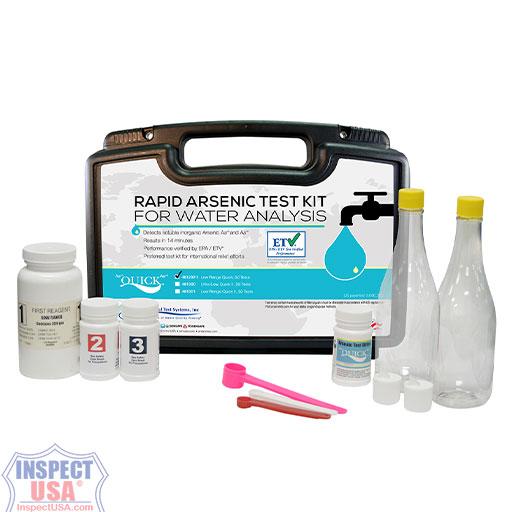
Arsenic Water Test Kit 2-50 ppb (481297-I) 50 Tests 12 Minute Result
Reference only — not for sale
| Model | 481297-i |
|---|---|
| Manufacturer | ITS |
| Category | Water Testing |
| Status | Discontinued |
Product details (archived)
The information below is retained for reference only. This item is discontinued and cannot be ordered.
Arsenic Water Test Kit 2-50 ppb (481297-I) 50 Tests 12 Minute Result
Detection levels: <2, 4, 10, 15, 20, 25, 30, 40, 50, 60, 70, 80, 100, >150, >300 ppb (µg/L)
Low Range Arsenic Quick™ is the premier product in the Quick line of arsenic water quality testing kits. Yielding results in only 12 minutes, Low Range Arsenic Quick™ combines low sensitivity with ease-of-use. Ideal for on-the-spot field testing, Low Range Arsenic Quick™ gives you the tools for tomorrow, today. With the US EPA imposing new, stricter regulations pertaining to arsenic in drinking water, many of the testing methods currently used today will be rendered inadequate in the future. Low Range Arsenic Quick™ has been designed to give you a water quality testing kit that is good for today, tomorrow and the future. Requiring no technical expertise, Low Range Arsenic Quick™ is a tool that can be utilized by all members of your staff.
Safety has not been compromised for convenience in the Arsenic Quick™ family of arsenic field test kits. All reagents are in powder form and have been carefully selected to minimize the hazards associated with conventional arsenic testing. All components needed to accurately detect and measure arsenic are included in a portable ready-to-use kit.Our easy to follow test procedure requires only three reagents and as little as 12 minutes to perform. Reagents are clearly labeled and color coded to make arsenic testing error free. A colorimetric test strip is used to take the guesswork out of accurate arsenic measurement. The matching color chart is thoughtfully printed with extra large color blocks and contrasting colors for quick and accurate determinations.
Here's how it works:
First, your water sample is mixed in the supplied reaction vessel with reagent
#1 (Tartaric acid with rate enhancers). This will acidify your water sample.
Reagent #2, an oxidizer, is then added to remove hydrogen sulfide interference.
Finally, with the addition of Zinc powder, reagent #3, inorganic arsenic
compounds (As+3 and As+5) are reduced to arsine gas. A test strip is used to
measure the arsine gas concentration in the water sample.
As arsine gas is generated and comes in contact with the test strip, the
Mercuric bromide indicator on the test strip changes in color from white to
shades of yellow or brown. Once the reaction is completed, the test strip is
removed and matched to a calibrated color chart to obtain a quantitative measure
of arsenic in the tested sample.
The included test procedure is designed to detect inorganic arsenic As+3 and
As+5. Test procedures are also available for arsenic in soil.
Supplied with:

Available replacements in Water Testing
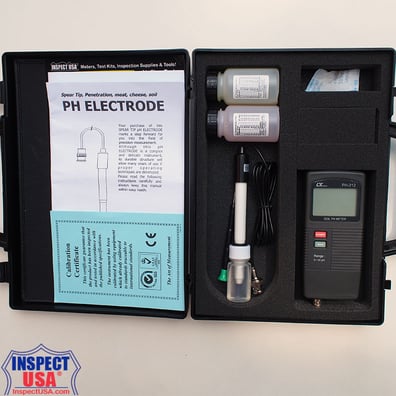
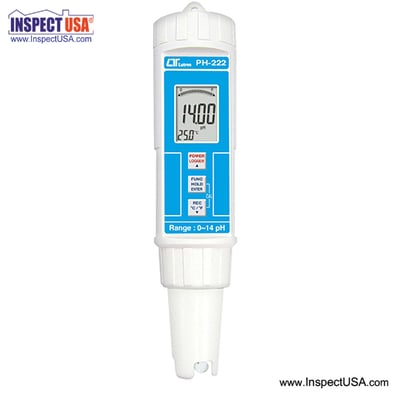
Lutron pH 0-14 Meter Kit (PH-212) Liquids, Soil & Foods
$216.90 now $189.00