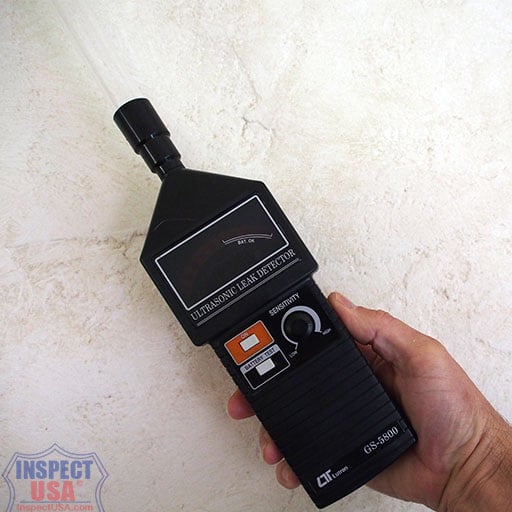
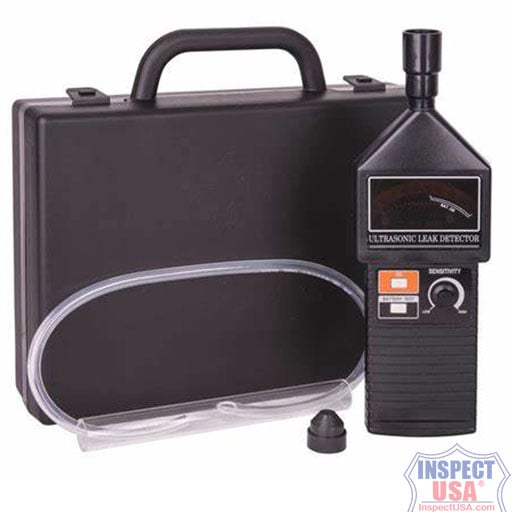
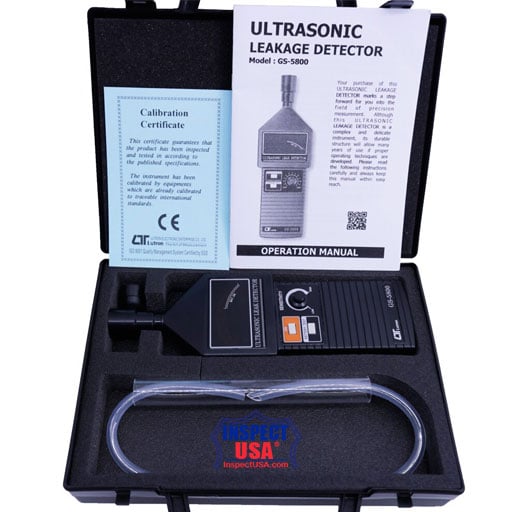
Lutron GS-5800 Ultrasonic Leak Detector, 20 kHz to 100 kHz, with Case
The Lutron GS-5800 finds leaks by listening for sound you cannot hear. When gas or air escapes through a small opening, the turbulence at that opening generates ultrasonic noise — above 20 kHz, well past the roughly 18 kHz ceiling of human hearing. The detector picks up that noise, shows its strength on a bar LED display, and converts it down into an audible tone through the built-in buzzer or an optional earphone.
Ultrasound is highly directional, and that is what makes the method work: the closer the sensor horn comes to the leak, the stronger the tone and the higher the bar display climbs. Turning the sensitivity down and sweeping again narrows the area, and repeating that takes you to the exact point. Unlike soap solution it needs no contact with the surface, and unlike a refrigerant sniffer it does not care which gas is escaping — any pressure or vacuum leak makes the same kind of noise.
Paired with the optional GS-400 ultrasonic transmitter, the detector also finds openings with no pressure behind them at all. The transmitter is placed inside a vehicle, a room or a duct, and the detector is swept along the outside; wherever sound gets through, there is a gap. That is how door and window seals, windshields and roof penetrations are tested.
This detector is not intended for use with flammable gases.
Typical Applications
With the detector alone:
- Compressed air leaks in shop lines, fittings, couplers and hose — usually the fastest payback, since leaking air is metered electricity.
- Pressure and vacuum leaks in refrigeration and air conditioning systems.
- Leaks in heating systems and internal leaks in steam traps and transfer lines.
- Tire and tube leaks.
- Engine seals and brake system leaks.
- Electrical arcing, which produces a strong ultrasonic signature.
- Bearing condition checks.
With the detector and the GS-400 transmitter:
- Air leaks around door and window gaskets and seals.
- Water leak paths in roofs, before water ever appears inside.
- Windshield, door and trunk seal leaks on vehicles.
- Conduit and pipe identification — tracing which run goes where.
Features
- Locates the source of ultrasonic emissions generated by gas and air leaks.
- Leakage level shown on a bar LED display panel.
- Ultrasonic sound converted to an audible tone through the internal buzzer, or through an optional earphone for noisy areas.
- Wide frequency response, 20 kHz to 100 kHz.
- Adjustable sensitivity, so a strong signal can be narrowed down to a precise point.
- Battery test button with a BAT OK indication on the display panel.
- Rubber bottle plug with plastic tubing included, to extend the sensor horn into tight or hazardous spots and shut out background noise.
- 1/2" PVC pipe included, which fits the horn to narrow its field of view and keep the operator clear of a hazardous area.
- Supplied in a hard carrying case.
- Runs on a single 9V battery.
Specifications
- Leakage sensitivity indicator: bar LED display panel and audible tone. The audible tone is the received ultrasonic frequency divided by 32.
- Frequency response: 20 kHz to 100 kHz.
- Sensitivity setting: adjustable by dial.
- Earphone output: 3.5 mm jack for the optional EA-100 earphone.
- Dimensions: 10.0 x 2.8 x 1.1" (255 x 70 x 28 mm), height x width x depth.
- Weight: 9.2 oz (260 g), battery included.
- Operating temperature: 32 to 122 °F (0 to 50 °C). NOTE most batteries are not rated for use below -4 °F or above 125 °F.
- Operating humidity: less than 80% RH, non-condensing.
- Power supply: one 9V (006P, MN1604, PP3) alkaline or heavy duty battery.
- Power consumption: approximately 34 mA DC.
NOTE: The bar LED display is a relative measurement only. It shows where the signal is strongest so the leak can be located; it does not report a leak rate in calibrated units.
Accessories Included
- Rubber bottle plug with plastic tubing.
- 1/2" PVC pipe.
- Hard carrying case.
- Operation manual.
Optional Components
- Earphone, EA-100, for use in noisy environments.
- GS-400 ultrasonic transmitter, 40 kHz, for testing seals and openings that are not under pressure.